-
Group Therapy: In Person
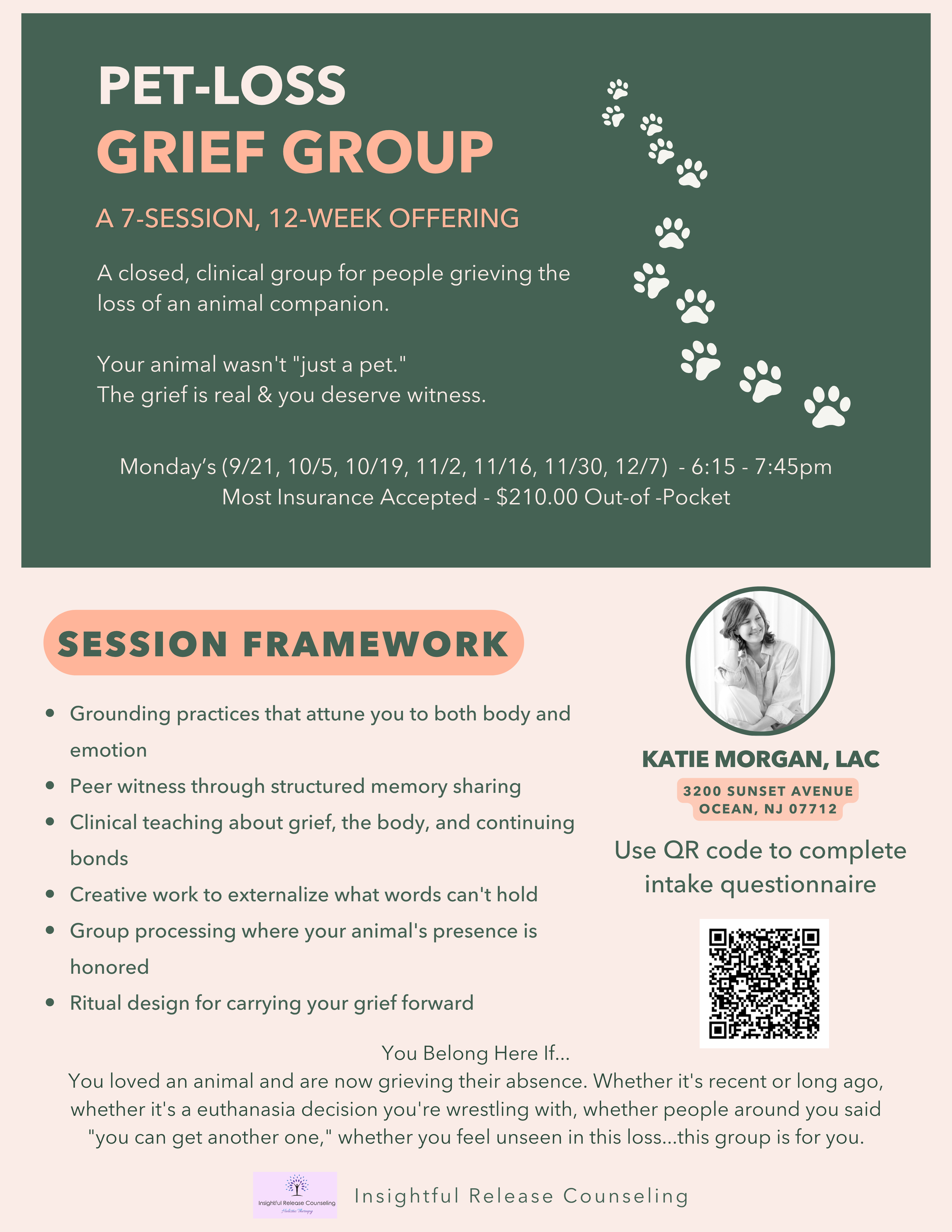
7-Session Pet Loss Grief Group
A Closed, Time-Limited Group for Those Grieving the Loss of an Animal
Your animal wasn't just a pet. They were family. They lived in your daily rhythms, in your body's knowing, in how you moved through your home and your days. Their absence is real and the loss deserves witness.
This group exists because the world often doesn't know how to hold pet loss. Friends mean well and say things that sting: "At least they're not suffering." "You can get another one." "It was just a pet." But you know the truth: the bond was irreplaceable, the grief is legitimate, and the mourning deserves space and time.
This is a clinical, trauma-informed group for people whose most intimate relationships include animals. It's a place where you can say their name, hold their memory, and process the specific grief of losing a daily companion.
How It Works
Over seven sessions across twelve weeks, we gather for 90-minutes. The structure is consistent, creating safety and predictability as your nervous system learns to process this loss.
Each session includes:
A grounding practice that attunes you to both body and emotion
A structured moment to share memory and story, sitting with another griever
Clinical teaching about grief, the body, continuing bonds, and what's actually true
Hands-on creative work like drawing, writing, collage, building, integrated to externalize what words can't yet hold
Group processing where you're witnessed and your animal's presence is honored
A closing practice you can carry into your week
We use actual grief practices from research-backed frameworks: Dr. Alan Wolfelt's companioning model, TIST (Trauma-Informed Stabilization Techniques), and continuing bonds theory. This means you're learning the language for what you're experiencing, and you're not alone in it.
The Framework
This group is grounded in three core clinical principles:
Trauma-informed care: We understand that losing an animal can be traumatic...the finality, the decision-making, the absence after daily presence. We pace gently and we don't rush past the hard parts.
Continuing bonds: Your animal isn't gone from your life. The relationship changed form but didn't end. This group helps you discover and honor that ongoing presence.
Companioning, not fixing: Grief isn't a problem to solve. We don't tell you how to grieve or when to "move on." We walk alongside you. We witness. We hold. We acknowledge that mourning is active work, and this group is that work.
Who This Group Is For
This group is specifically for people who have lost an animal...whether the loss was recent or years ago, whether it's a dog, cat, horse, bird, rabbit, or any animal whose presence shaped your daily life.
You might be a good fit if:
You loved an animal deeply and are now grieving their absence.
You're struggling with guilt about a euthanasia decision.
You feel unseen or minimized in your grief...family and friends don't understand the magnitude of the loss.
The animal's absence has changed your daily routines and you're learning to navigate the silence.
You're mourning alone and need witness, structure, and community.
You want to understand how to carry this grief without resolving it (because it shouldn't be resolved).
You want to explore how the animal continues to live in you, transformed.
This group is not a fit if:
You're experiencing acute psychiatric crisis requiring more intensive support.
You're unable to commit to 7 sessions over 12 weeks.
You're currently grieving a human death and need that to be the primary focus of therapy.
Note: All bodies, identities, family structures, and faith backgrounds are welcome. LGBTQ+, neurodivergent, disabled, and multiply marginalized people belong here without needing to explain yourselves.
What Makes This Different
Closed group: The same 5-8 people for all eight sessions builds trust and intimacy. You're not starting over with new faces each week.
Structured, consistent framework: You know what to expect. That safety is clinical. It lets your nervous system relax into the work.
Peer witness embedded: Each session includes "speed dating" memory sharing...sitting with another griever, saying your animal's name, being heard. This isn't about the facilitator holding all the stories. It's about community holding community.
Clinical grounding: Teaching about TIST, continuing bonds, and companioning helps you understand what's happening in your body and nervous system. Expertise without performance.
Creative before verbal: Sometimes the hands-on work of drawing, writing, making, opens what words alone can't. Every session includes time to create before processing.
Ritual design: By the end, you've designed a practice you'll actually use...how you'll remember, honor, and carry your animal forward. Grief doesn't end; it integrates. This group helps you create the structure for that.
Logistics
When: Monday's (9/21, 10/5, 10/19, 11/2, 11/16, 11/30, 12/7)
Duration: 90 minutes per session
Location/Format: [In-person @ 3200 Sunset Avenue, Suite 200, Ocean, NJ 07712]
Group size: 5-8 people (closed group)
Insurance: Covered by most insurance plans as clinical group therapy
What to bring: Openness. Grief. Journal or notebook.
The Application Process
To ensure this group is a good fit for you and for the group, we ask that you complete a brief intake questionnaire. This helps me understand your loss, your support system, and whether this is the right container for you at this time.
[Click here for intake questionnaire]
After intake, you'll receive clinical paperwork to complete, and we'll schedule a brief call to answer questions and confirm your participation.
What Grief Researchers & Clinical Leaders Say
"The goal of mourning is not to 'let go' or 'move on' but rather to integrate the loss into our ongoing lives while continuing our relationship with the person who has died. The death changes the form of the relationship, but it does not have to end it." —Dr. Alan D. Wolfelt, Understanding Your Grief
"Someone needs to encourage us not to brush aside what we feel. Not to be ashamed of the love and grief that it arouses in us. Not to be afraid of pain. Someone needs to encourage us: that this soft spot in us could be awakened, and that to do this would change our lives." —Pema Chödrön, When Things Fall Apart
Your Facilitator
I'm Katie, a Licensed Associate Counselor specializing in grief and trauma. I run this group because I've witnessed how deeply animals shape us, how real the loss is, and how little the world validates it.